Pluvicto: The Prostate Cancer Drug That Just Moved Up the Line


From last resort to first move
Prostate cancer is diagnosed in about 1.5 million men worldwide each year and kills roughly 420,000, including more than 41,000 in Canada and the United States alone. For years, a radioactive drug called Pluvicto was a last resort for men with advanced prostate cancer, offered only after hormone therapy, and often chemotherapy, had stopped working.
That changed on July 31, 2026, when the US Food and Drug Administration (FDA) approved Pluvicto for men whose prostate cancer has spread but still responds to hormone therapy. Novartis, the company that makes it, says the decision nearly doubles the number of patients who can receive it.
To understand why that matters, let's talk about how this drug recognizes not just any cancer cell, but prostate cancer cells specifically.
A flag on the cancer cell
Most prostate cancer cells carry a protein on their surface called PSMA, short for prostate-specific membrane antigen. Roughly 80% of prostate cancers have it, often in large amounts, while most healthy tissue has very little.
Think of PSMA as a flag planted on the cancer cell's surface. If you can build a molecule that recognizes the flag, you can deliver almost anything directly to the cell.
A guided missile, not carpet bombing
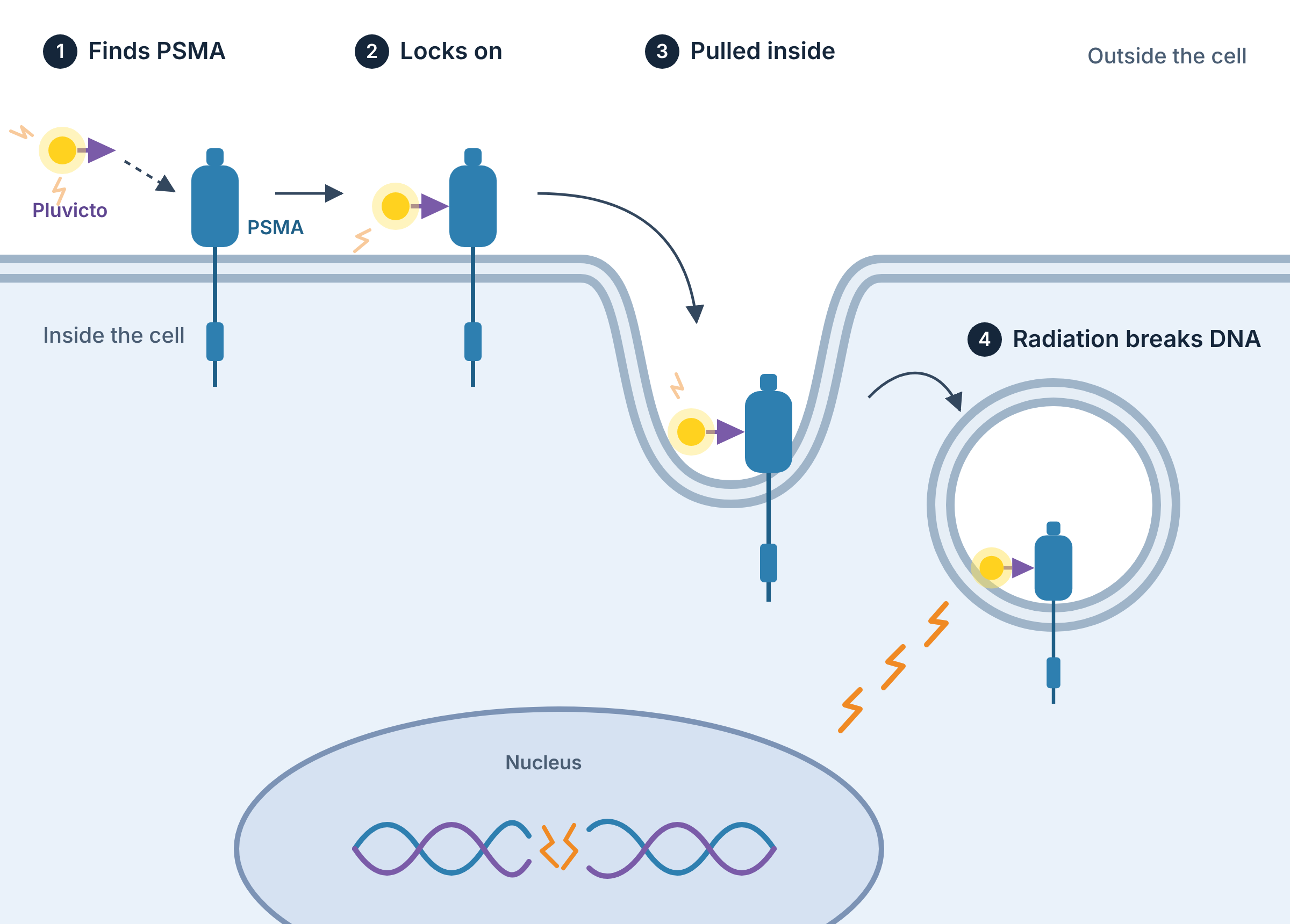
Pluvicto has two parts. The first is a small molecule that recognizes and latches onto PSMA. The second is lutetium-177, a radioactive metal that can kill nearby cells, held in a tight molecular cage so it stays attached.
I spend my days building molecules like this in the lab, and the real challenge is always the same: getting the targeting molecule to find the right cells while ignoring everything else. Pluvicto does this remarkably well, but as with everything, it's not perfect, as you'll see.
Once injected, the drug travels through the bloodstream until the targeting molecule finds PSMA, locks on, and is pulled inside the cell. The lutetium then gives off radiation that damages the cancer cell's DNA and can kill it, along with its closest neighbours. That radiation travels at most about 2 millimeters, so the damage stays concentrated where the cancer is.
Compare that with conventional radiation therapy, which aims a beam through the skin at a tumour doctors can already see. That works well for one tumour in one place, but poorly for cancer that has spread to dozens of spots in the bones and lymph nodes. Pluvicto reaches the cancer wherever it has spread.
Treatment is one infusion every six weeks, for up to six doses.
See it first, then treat it
Before anyone receives Pluvicto, they need a PSMA PET scan. The scan uses the same targeting trick but swaps destructive radiation for a tiny dose of a different radioactive tag that a PET scanner can detect. If the cancer lights up on the scan, the flag is there, and the treatment has something to grab.
This pairing is called theranostics, a blend of therapy and diagnostics. Think of it as one key that opens two doors. The imaging version shows doctors where the cancer is hiding. The treatment version attacks it in those same places.
This scan also protects you. If your cancer doesn't light up, the drug has nothing to bind to, and you're spared a treatment unlikely to help.
What the trial actually showed
The approval rests on PSMAddition, a phase III trial that enrolled more than 1,100 men with PSMA-positive prostate cancer that had spread but still responded to hormone therapy. Every patient received standard hormone treatment, and half were randomly assigned to also receive Pluvicto.
- Slower disease: Adding Pluvicto cut the risk of cancer progression or death by 28% at the first analysis and by 33% with longer follow-up.
- Survival: Results lean in Pluvicto's favour, but the difference is not yet statistically confirmed. The survival data are still maturing.
- Side effects: Serious side effects occurred in 50.7% of patients on Pluvicto versus 43.0% on hormone therapy alone. The most common were dry mouth, fatigue, nausea, hot flushes, and anemia. Quality of life held steady.
Why dry mouth? Your salivary glands also carry PSMA, so they soak up some of the drug.
The catch is that slowing cancer isn't the same as helping people live longer. Many men in the hormone-only group went on to receive Pluvicto after their cancer progressed, which can blur any survival difference between the two groups. The final survival analysis is the number we should all be watching.
Timing is everything
Pluvicto has been moving steadily up the treatment line:
- 2022: approved only after both hormone therapy and chemotherapy had failed.
- 2025: approved after hormone therapy, so patients could delay chemotherapy.
- 2026: approved alongside hormone therapy, while the cancer still responds to it.
Each step brings the drug to patients who are generally healthier and whose cancer has had less time to adapt. Once prostate cancer stops responding to hormone therapy, it gets much harder to control. So the idea is to hit it hard before it learns to resist.
It's the difference between pulling weeds while they're seedlings and waiting until the roots have spread under the whole garden.
Approval is not the same as access
FDA approval doesn't mean patients get the drug the next day.
- Slow start: On its October 2026 earnings call, Novartis said it hadn't yet seen uptake pick up in this new group of patients. Pluvicto requires a PSMA PET scan, a nuclear medicine team and a referral from the urologist, and many clinics are still building those links.
- A second round: Researchers are testing whether patients can safely receive Pluvicto again later in their disease. Early safety data from one such trial, Re-LuPSMA, were presented at the European Society for Medical Oncology congress in October 2026.
- Canada: Health Canada approved Pluvicto in 2022 for men whose cancer no longer responds to hormone therapy. As of late October 2026, it hadn't approved the drug for this earlier, hormone-sensitive stage.
If you or someone you love is living with advanced prostate cancer, two good questions for the oncologist are whether a PSMA PET scan makes sense, and whether Pluvicto is an option where you live.
The bigger picture
Pluvicto is part of a larger shift in cancer care toward radiation that works like a drug and is delivered by molecules that know where to go. Pharmaceutical companies are now racing to build the same kind of treatment for other cancers, using other flags and more powerful radioactive payloads.
But who first thought putting radioactive material inside a human body was a good idea? And why? The answer goes back more than a century, to a young chemist who suspected his landlady was serving him yesterday's leftovers. A scientific history nugget is coming your way next. Stay tuned!
Sources
- Novartis: FDA approves Pluvicto for PSMA+ mHSPC (July 31, 2026)
- FDA: Oncology approval notifications
- Precision Medicine Online: Novartis nets third FDA approval for Pluvicto
- AuntMinnie: Novartis secures expanded approval for Pluvicto
- CURE: FDA approves Pluvicto plus hormone therapy
- UroToday: PSMAddition trial updates
- Investing.com: Novartis Q3 2026 earnings call
- UroToday: ESMO 2026 highlights
- Health Canada: Summary Basis of Decision for Pluvicto
- ASCO Post: Global Cancer Statistics 2024
- American Cancer Society: Prostate cancer key statistics
- CMAJ: Cancer in Canada 2026